|
New Apparatus
Added to the Three Fine Engines
and a
If
all the recent clamor about the fire department, whether it be just or
unjust--and official investigation has established the fact that much of
it was unjust--shall result in informing the people of Los Angeles as to
just what kind of a fire department they have, it will not have been in
vain. No wonder the fire fighters of the city have been so prominently before the public during the past two months, for during that period all previous records for big fires, for number of alarms and for losses were broken. The ninety-one alarms during the month of November made a new record, being the greatest number of alarms during any thirty days of the fire department's history. December set the mark much higher, however, and the record for the month is now 104, that being the number of alarms to which the department had responded up to 5 o'clock yesterday afternoon. Of these 104 alarms, 93 were actual fires, and only 11 were false. Three of the fires were of such magnitude that second alarms were necessary. There was one three-alarm fire and one-that at Hotel Van Nuys Broadway--caused a general alarm, being the only fire in the history of the city for which every piece of apparatus then in service was called out. The loss as estimated by the fire department was $310,465, but the actual loss considering loss of business and damage to surrounding property not reached by fire was probably 50 per cent higher.
|
|
MANY MACHINES, FEW MEN In point of equipment the Los Angeles fire department stands second to no city of its size in the country, but the size of the city is such, the area to be protected so large that the present equipment is, according to the opinion of insurance experts, about two-thirds what it should be. That is to say, the experts believe the department should be increased by one-half. With all the fine equipment the department is deficient in men. Engine companies which in eastern cities consist of eight or ten men are here limited to five or six. Not one of the engine companies in the outlying districts can lay two lines of hose and have men sufficient to hold both nozzles without aid from outside the department, for it requires three men to hold the end of a line and direct the stream when one of the modern high-class engines gets to working at anything like its full capacity. Within the next few days there will be added to the equipment of the department several pieces of apparatus of the most modern type, the best that is to be had in any market, and with it in service the department will be better prepared than ever before to cope with large fires, such as this city may expect from time to time.
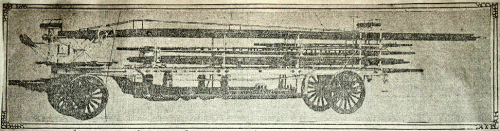
At the headquarters house on Hill street near Second will be placed in service the new Seagrave truck which is considered the best of its kind. It is built by the Seagrave Company of Columbus, O., and was delivered a few days ago. The aerial ladder has no equal in the world in simplicity or speed in operating. The 85-foot ladder is a mere toy in the hands of the operator, the instant the horses are stopped at the burning building the operator is at his post on the platform raising the ladder by simply turning the crank with one hand and while elevating, an assistant is running out the extension, and the whole ladder is being turned on its turn-table and tipped against the building at its extreme height of 85 feet. The whole operation consuming twenty seconds. The mechanism by which this ease and speed is accomplished is very simple. The ladder is raised and lowered by means of a screw and bevel gear wheels turned with cranks. Two cylinders attached to the turntable, each containing finely-tempered, spiral springs represent the lifting power of several men. A piston rod with a head rests against each set of sprigs in the cylinder, and as the ladder is raised the springs expand, helping to raise the ladder. The ladder's own weight in lowering contracts the springs. The ladder is in two sections; an automatic lock on the upper section catches any rung of the lower section as the extension is being raised and holds it at the desire height.
|
|
The whole ladder can be tilted to any desired degree. Besides the aerial ladder there is carried on the truck a complete assortment of portable ladders and a full equipment of fire-fighting tools. The wheels of the truck are roller bearing, reducing the friction to a minimum; they also have four-inch solid rubber tires. The color of paint on the wheels and gear is a rich wine, on the frame white, and the ladders finished in natural wood.
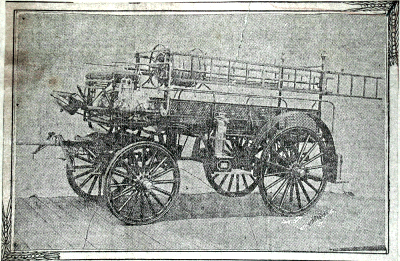
From the Seagrave company the city has also purchased several combination chemical engines and hose wagons of the latest and most improved pattern. These will displace the antiquated hose reels which are now in use in several engine-houses in the residence districts The wagons will each carry 1000 feet of hose and each has a ninety-gallon tank for chemicals. Nearly all the engine-houses in the city are equipped with wagons of this kind, and time after time they have paid for themselves by making it possible to extinguish incipient blazes before it became necessary to deluge a house with an engine stream. NEW ENGINES ALSO. Three new streamers will be put in service before the end of the month. They are all of the third class--the class referring to size only--but except for the difference in size they are as efficient as the magnificent big machines quartered in the business district. One of these new engines will be sent to the No. 15 engine-house at Jefferson street and McClintock avenue to take the place of the old engine, which will be rebuilt and held in reserve. The others will be quartered at the two new houses recently completed, one in the Harvard Heights district on West Adams street, and the other in the heart of the manufacturing district on North Main street, near Ann. The City Council will this week pass the necessary ordinance creating the new companies and from the eligible list of civil service applicants the men to compose the new companies will be selected. Before February 1 the two houses will be occupied. With these additions the fire department will consist of 19 engine companies, 4 trucks, 2 chemical companies, 3 hose companies and 1 water tower, with two steamers in reserve. These companies will consist of 203 men. AUTOMOBILE FIRE ENGINE The automobile having come to stay and having been adapted to all kinds of traffic, the day may come when it will displace horses on all fire-fighting apparatus. The chiefs of the big eastern departments have used automobiles instead of buggies for years. The Pope Manufacturing Company of Hartford has built a combination chemical engine and hose wagon of the automobile pattern and the thorough tests to which it had been put have proven that the idea is a practical one. Equipped with a powerful engine, this piece of apparatus can make greater speed than horses and can also ascend hills up which it would be impossible for any team to pull a heavy engine. A number of eastern cities are investigating along this line and the automobile fire engine may soon be placed in general use. _________
|
Los Angeles Times, January 1, 1906
LAFIRE.COM
Copyright 2001 All Rights Reserved.