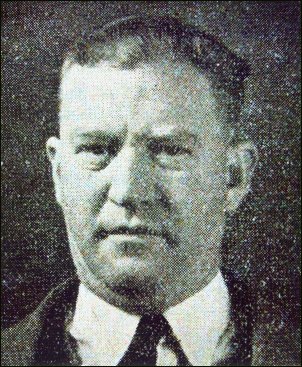
On December 1, 1923, Captain Augustine was promoted to the
rank of Battalion Chief, was assigned to Battalion 7 on the B platoon, and
he took Red with him to be his operator. A short time later, June 16,
1924, "Red" was promoted to autofireman. From then on it seemed as though the men with the gold buttons competed
in getting "Red" to be their operator. Chief Augustine lost him to
Assistant Chief Edwards, who in turn lost him to Deputy Chief McDowell, and when Bert
Blade succeeded Chief McDowell as Deputy Chief he to kept "Red." It was
while operating for Chief Blake that "Red" answered his last alarm, the one that
was to result in his death.
Over on Broadway the fire in the Gray building was rapidly getting out
of hand on November 6, 1939, and when the 9-2-1133 came in for that fire "Red,"
driving Chief Blake who responded on the second, rolled to his last big fire. It was
while "Red" was leading the rescuers in an attempt to extricate the body of John
Kacl that he was injured, although at the time neither he nor anyone else realized it.
As they had just about uncovered Kacl's body another of the upper floors came
crashing down upon them and amid this debris "Red" was struck across the helmet
by a heavy floor joist. Dazed, he went outside and sat on the curb to rest a minute
and sort of sweep the cobwebs away. He continued working despite a severe headache
which lasted for several shifts. A few days later, while driving for Chief
Augustine, who was acting as Deputy, "Red was out at 66s sleeping in, when about 4:30
in the morning he awoke to find himself in a paralyzed condition and unable to stand.
The ambulance and doctor were called from the 77th street police station and Dr.
Paulson, who responded, could find no evidence of paralysis. The spell wore away and
at 7:30 of the same morning "Red" drove the Chief back to headquarters.
"Red" went off duty that morning and decided that a few day's rest would
bring him around to his old self again. The rest seemed to agree with him and to be
doing some good until the morning of December 11 when he had another spell of the
paralysis. Once again Dr. Paulson of the 77th street station responded and by now
believed that "Red" might have a possible ventral hemorrhage of the brain.
This belief prompted him to bring "Red" into the Receiving Hospital at
9:09 a.m. About noon time "Red" was once again feeling pretty good and was
sitting on the edge of the bed talking to Chief Blake, when all at once he folded up and
slid off onto the floor. He was quickly placed in bed and Rescue 23 was summoned to
provide assistance in breathing but despite this "Red" passed away at 7:40 p.m.
John C. Hough was born in Boulder, Colorado, November 7, 1893, and
was survived by his widow, Helen C. Hough. Funeral services were held at the Bramble
Funeral Home on December 15, 1939, and further services were conducted at Forest Lawn by
the Builders' Club, the Masonic order of which he was a prominent member. Among a
long list of prominent honorary pall bearers, the active bearers were Bert M. Blake,
W. H. Augustine, A. W. MacDougall, William Barclay, C. A. Halter, and G. C. McKee.
Thus "Red" Hough passed on to join the man he had so valiantly attempted
to save in the fire gutted Gray Building.