|
|
||||
|
||||
|
For
the third time within two weeks the Death Angel reached into our ranks and
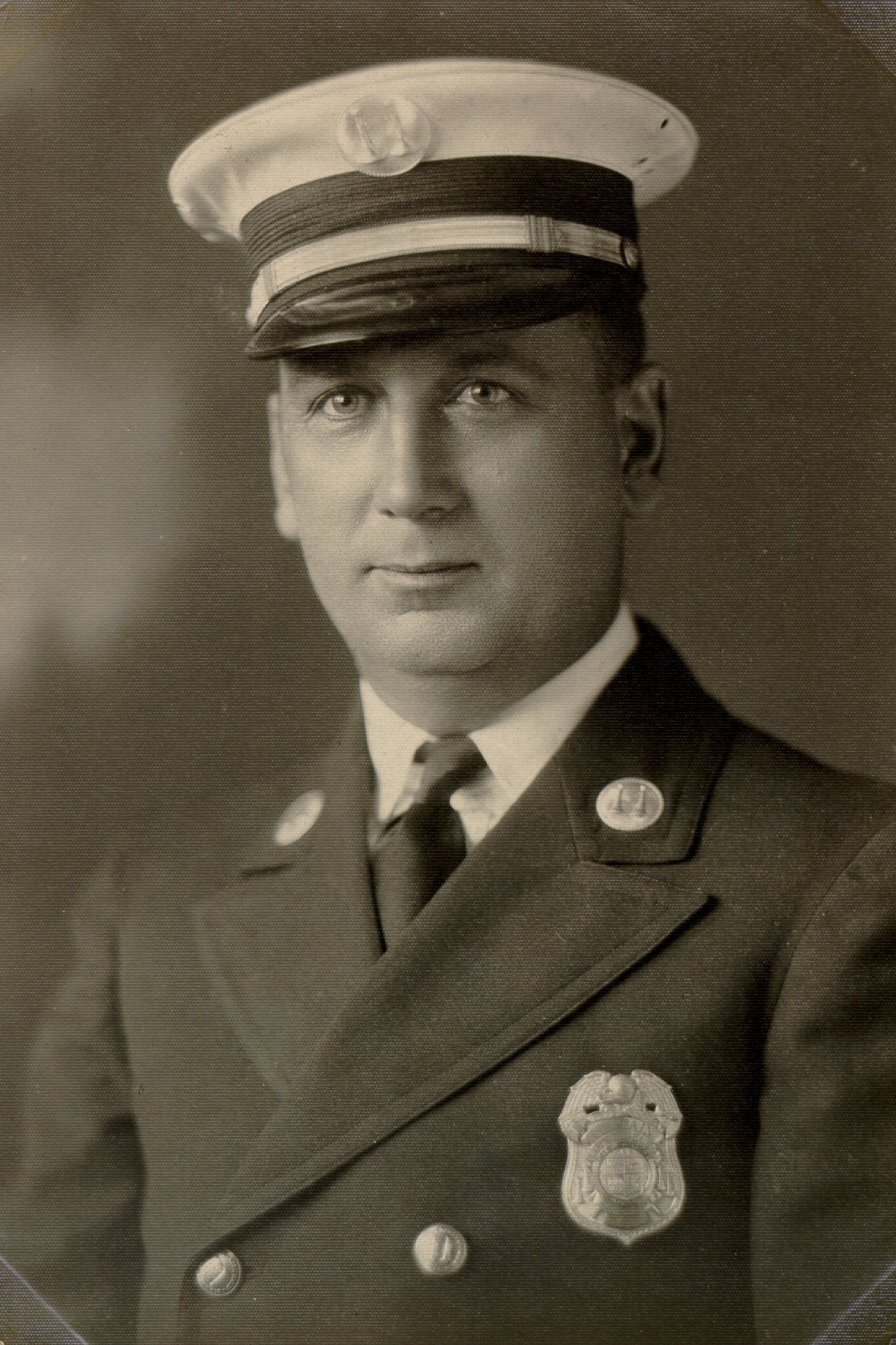
called another one of our beloved members. Captain Elwood H. Henry
was born in Pennsylvania, July 18th, 1888, came to California in 1911,
became a member of the Los Angeles Fire Department August, 1912. He
was married shortly afterwards to Miss Jessie Morrow. To this union
was given two fine sons, Elwood, Jr. and Freddie. He lost his life
on Sunday, September 14th while on duty, rescuing a child trapped in an
elevator. |
||||
|
The Firemen's Grape Vine, September 30, 1930 |
||||
|
|
||||
|
Little Gonzales had been playing in the elevator, riding up and down, on this Sunday afternoon, September 14, 1930, as he and other boys had done many times before, when the employees of the furniture company that used the building were absent for the week-end. On this particular day the elevator had stopped opposite the third floor and as other boys in the group attempted to restart the car, young Daniel climbed up onto the top of the cage and was going to slide down the cables. As he was about to go over the side of the car, it started upward. Frightened, he stepped onto the only recess available, that afforded by the narrow confines of a blind window. The car passed over his small body until it had to clear his head and this it jammed roughly back into the opening as it scraped by. Although seriously injured Daniel Gonzales managed to hang on to his perch and cry for help. As the other boys in the group ran to the Gonzales home, which was to the rear of the Fiskin building, Daniel's cries for help were heard by an employee of the furniture company who happened to be working in a remote part of the building that day. After quickly surveying the situation this employee put through a call to the fire department. At 4:44 p.m., almost simultaneously the phones rang in the quarters of Engine 10 and at Truck 11, located with Engine 30. At 10s Captain Elwood Henry, Captain of Engine 10 on the B platoon, but acting chief of Battalion 4 on this fateful Sunday, answered the phone and was given the address on East Pico which he gave to his operator, Ainsley D. Cornwall, as the red buggy sped out of quarters. Arriving at the location Captain Henry found the members of Truck 11 under the
command of Captain Harry A. Brown already at work trying to fee the injured boy from his
dangerous plight. First raising a 30-foot straight ladder in the shaft, they were unable
to reach the boy due to the 15-foot well of the shaft below the first floor. Returning to
the truck they next put a 50-foot Bangor up in the shaft and operator Ainsley Cornwall,
under Captain Henry's instructions, went aloft and brought the injured lad to safety. An
ambulance was summoned from the Georgia Street Receiving Hospital to where little Gonzales
was removed in a critical condition. Meanwhile Captain Henry went through the rest of the
building to see if there were any more injured or trapped boys on the upper floors.
Finding none he returned to the main floor and gave orders to the truck company to pick up
and go home. Taking one last look around the Captain went out of the building and as he
was about to get into his buggy a voice in the small knot of spectators, attracted by
sirens and shiny red apparatus, called out: "There is another boy trapped up in the
shaft." |
||||
|
Outside Operator Cornwall and the members of Truck 11 were startled by a loud and reverberating crash. Rushing into the building Cornwall found Captain Henry lying unconscious in the bottom of the shaft 15 feet below the main floor. The jammed half open gate supporting one end of the plank on which Captain Henry had been standing dropped free, causing the plank to slip off on one end and pitched him down into the pit. The crash also brought the truckmen back to the scene and they quickly put a ladder down to the bottom of the shaft and with an improvised stretcher brought the heavy body of the injured officer to the ground level. Another ambulance summoned by Operator Cornwall soon arrived and the still unconscious Captain was removed to the receiving hospital. At the hospital after a thorough diagnosis it was determined that Captain Henry suffered a double basal skull fracture and that he had little or no chance for recovery. Assistant Chief Edwards, commander of the B Platoon sent for Mrs. Henry and the Captain's two sons. In their presence at 9:07 p.m. that same evening he passed away without ever regaining consciousness. Thus within the short period of three months the angel of death had reached out and taken another member of the department, this time a most ardent and enthusiastic worker. A man who was known throughout the Police Department and other organizations as well as his own Fire Department. Captain Elwood Henry was Secretary of the Fireman's Relief Association, Secretary of the Fire and Police Protective League, and a prominent member of the Builders Club, a Masonic order of firemen. A man of great sincerity, he devoted his boundless energy to the services of his fellow man rather than to the gain of his own ends. He left a gap that has never been completely filled. On Thursday afternoon, September 18, in the main auditorium of Angelus Temple, floral offerings such as were seldom seen, brought their silent message of the respect and love of the throng of friends and loved ones who mourned the loss of Captain Henry. Shortly after one o'clock the crowd began to
assemble outside the Temple. Great loads of flowers arrived and soon the entire
platform and altar space of the Temple were completely filled with floral
blossoms. At the head of the gray casket where Captain Henry lay as though
sleeping, was a floral design of red roses in the shape of a fire box which bore
the inscription, "Box 5371" from which box he had received his last call to
duty. Surrounding the casket were flowers from the various divisions, battalions
and companies of the Fire Department as well as many blossom tributes from the
various Police Department groups and other friends who had known and respected
Captain Henry. On the casket lay his uniform cap which could never be worn
again, and upon the breast of the uniform which Captain Henry had so honored by
heroic service, there was pinned the badge of his department. It seemed to shine
a little more brightly than ever before, as though it were reflecting the last
rays of greatness from the staunch heart, now stilled, beneath it. |
||||
|
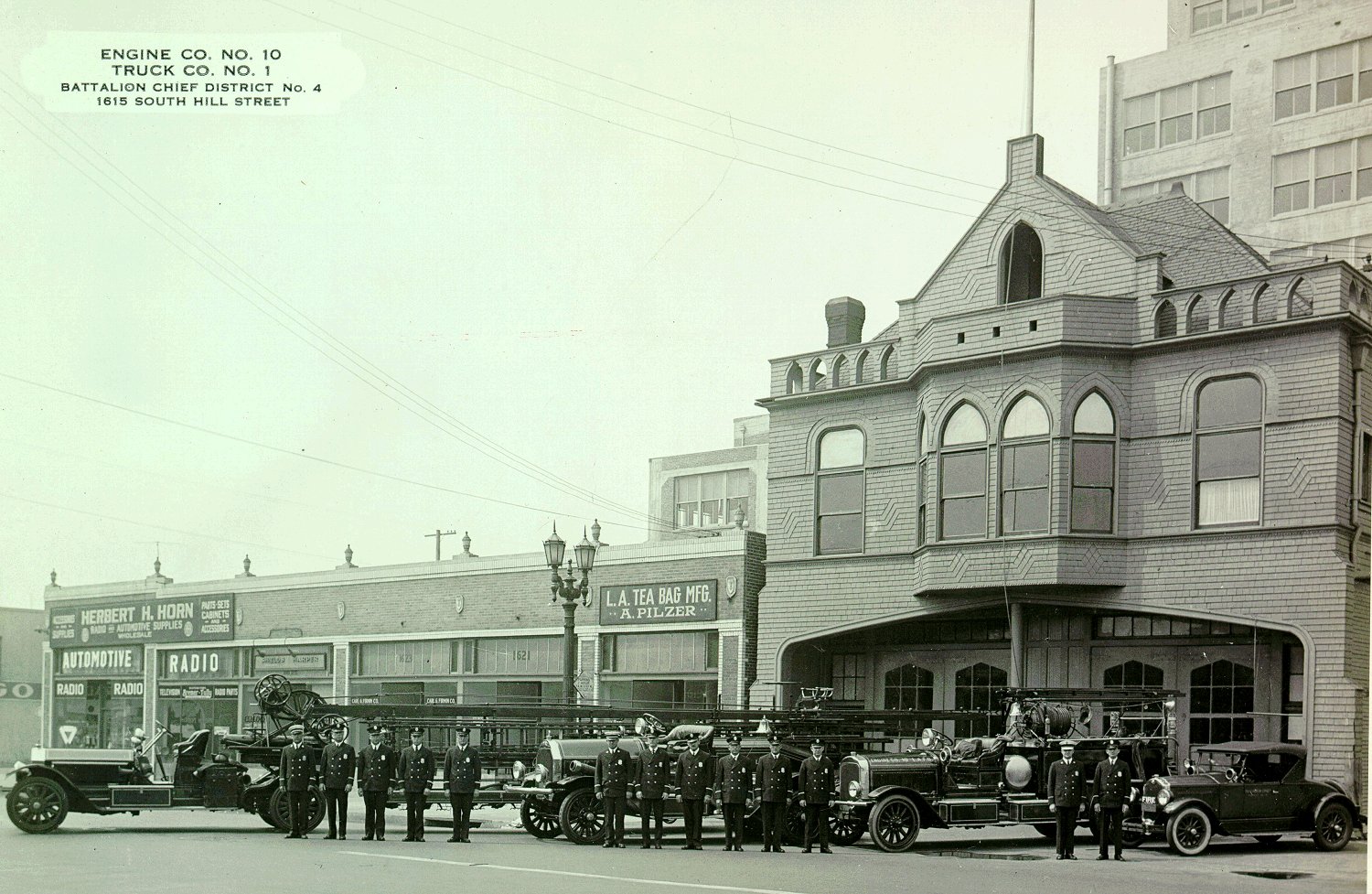
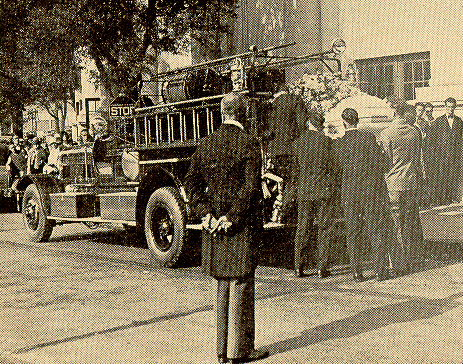
Several days before his death, in the quarters of Engine 10, Captain Henry had said: "Boys, there is always a chance in our work that some of us may go West. Some folks have their own ideas of the way they would like to pass on. As for me I don't want much fuss. But there is just one thing I'd like to have if I ever pass on in this game, and that is that you'll let me have my last ride on a truck." And so true to Captain Henry's last wishes, following the church services, the remains were carried to Inglewood Cemetery in his own wagon from Engine 10. The Moneta Masonic lodge of which he was a prominent member, held the last services at the cemetery. Captain Henry was born of Scotch-Irish parents in Red Lion, Pennsylvania on July 12, 1888. He was appointed to the Los Angeles Fire Department on July 6, 1912, was made a regular Lieutenant on April 5, 1922, and a regular Captain on January 17, 1924. He started his fire department career on the Fire Prevention Bureau, then in its infancy, and finished the balance of his eighteen years service at Engines 5B, 19B, 24A and 10B. He left behind his widow, Mrs. Jessie Henry, who passed away August 20, 1936, and two sons Elwood, Jr., and Fred. Elwood, Jr., now 31, is a member of the U.S. Coast Guard and when last heard from was serving in Northern Pacific waters. Fred, now 19, and whose guardian is Tom Carmichael, is also a member of the Coast Guard and a gun captain on a freighter operating out of Calcutta, India.
|
The Grape Vine, October 1944
LAFIRE.COM
Copyright 1999 All Rights Reserved.