|

Daniel Hayes was
the inventor of the modern aerial ladder fire truck. In 1868 he designed, and mounted, an
extension ladder that was raised by a spring-assist mechanism from the top of a ladder
truck. This “aerial ladder” invention revolutionized the use of ladders at
fires. The Hayes Ladder could be quickly raised to windows of burning buildings to rescue
victims. The San Francisco Fire Department continued to use the Hayes-designed aerial
ladder until the late 1950s.
Daniel D. Hayes
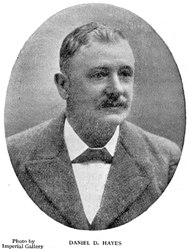 The name of “Hayes” is as familiar to
firemen all over the United States as household words. Where is there a fireman, who has
been a month in service, who does not know that the truck almost universally used in the
various fire departments of all the important cities of the Union is a “Hayes”
truck? Nevertheless, he may not know much about the inventor, or the reason why this
particular apparatus was so named. The San Francisco Fire Department can boast the honor
of having first introduced this truck into use. It was invented by a member of that
department who conceived the idea, and wrought it out in the perfection of this useful
apparatus, whilst he was filling the office of Superintendent of Steamers of this
department. Mr. Daniel D. Hayes who enjoys the distinction of being the inventor of the
truck named after him is still in the flesh. He is a native of New York City and did duty
as an active fireman in his native city prior to coming to California. For five years Mr.
Hayes was a member of No. 2 Engine Company of the Volunteer Fire Department of New York,
and for three years more he belonged to No. 42 Engine of the same department. He was,
therefore, an experienced fireman before Fate directed his steps to the Golden West. More
than that, he was a machinist, with an original turn of mind and it was this faculty that
Mr. Hayes owes his success in life. After eight years of voluntary and patriotic service
with the Volunteer Fire Department of the Empire City, Mr. Hayes severed his connection
with that department and went to work for the celebrated Amoskeag Company of Manchester,
N.H. He was the first engineer appointed in [the] New York Fire Department. The name of “Hayes” is as familiar to
firemen all over the United States as household words. Where is there a fireman, who has
been a month in service, who does not know that the truck almost universally used in the
various fire departments of all the important cities of the Union is a “Hayes”
truck? Nevertheless, he may not know much about the inventor, or the reason why this
particular apparatus was so named. The San Francisco Fire Department can boast the honor
of having first introduced this truck into use. It was invented by a member of that
department who conceived the idea, and wrought it out in the perfection of this useful
apparatus, whilst he was filling the office of Superintendent of Steamers of this
department. Mr. Daniel D. Hayes who enjoys the distinction of being the inventor of the
truck named after him is still in the flesh. He is a native of New York City and did duty
as an active fireman in his native city prior to coming to California. For five years Mr.
Hayes was a member of No. 2 Engine Company of the Volunteer Fire Department of New York,
and for three years more he belonged to No. 42 Engine of the same department. He was,
therefore, an experienced fireman before Fate directed his steps to the Golden West. More
than that, he was a machinist, with an original turn of mind and it was this faculty that
Mr. Hayes owes his success in life. After eight years of voluntary and patriotic service
with the Volunteer Fire Department of the Empire City, Mr. Hayes severed his connection
with that department and went to work for the celebrated Amoskeag Company of Manchester,
N.H. He was the first engineer appointed in [the] New York Fire Department.
|
|
His talents soon marked him out for
special recognition by the Amoskeag Company and in 1866 he was placed in charge of the
five steam fire engines of the Amoskeag patent, consigned by that company to the inchoate
Fire Department of San Francisco. These were the engines ordered by the Board of
Supervisors, in April, 1866, in anticipation of the advent of the paid fire department
then in process of organization. Mr. Hayes brought these engines to this city via Panama,
and having put them together on their arrival here, handed them over to the Supervisors.
On the new department going into service in December, 1866, Mr. Hayes was offered, and
accepted the position of Superintendent of Steamers. He was the first man to fill that
office, and for fourteen years, through all the storms of the political struggles of those
years, his fitness and capacity for such an office were never questioned. About the year
1868 he built the truck which has since made his name so famous. It completely
revolutionized the methods of fighting a fire and entirely did away with the old hand,
splice-ladder. A public trial of the apparatus was made, and was attended with signal
success. The fire department bought the Hayes truck at a cost of $3,000 and great things
were expected of it. But Chief [F.E.R.] Whitney, for some inscrutable reason, was
prejudiced against the new contrivance and it was relegated to a back seat. But the
Harpending fire, and the disastrous failures of the ladders then in use, stirred up a
storm of indignation at the ineffectiveness of the equipment of the department, and the
press strongly urged a trial of the Hayes truck, purchased three years before. The
opportunity came. On July 4th following the Harpending fire the fire department
took part in the parade of that day, and the Hayes truck, which had been assigned to No. 1
Engine, was in the procession. An alarm was turned in and Chief [David] Scannell ordered
No. 1 Engine to the scene of the fire. Mr. Hayes took charge of his truck at this fire,
which was on Washington street, and demonstrated beyond all shadow of a doubt the superior
excellence of his apparatus. From that time the Hayes truck became famous. At the present
time there are about 290 Hayes trucks in service in the United States. Brooklyn has
eighteen, Philadelphia fourteen and the fire departments of all the important cities are
equipped with this ingenious intention of Mr. Hayes. The overhead wires greatly interfered
with the process of raising the ladder of the Hayes truck, and to meet this a “ground
extension” was devised so that the ladder could be raised from the sidewalk. But to
render this arrangement perfectly effective Mr. Hayes’ inventive genius was called
into requisition. He invented and patented a simple, but highly useful, lever by which the
ground extension can be elevated from the sidewalk, and the ladder of the Hayes truck
raised despite the presence of the overhead wires. Mr. Hayes is also the inventor and
patentee of a “brass, universal, hydrant connection,” now in use on all the fire
engines in this city. The Hayes truck has a reputation that is not confined to this
country. Some years ago Captain Shaw, the famous Chief of the London Fire Department, saw
one of these apparatus and was so struck with its usefulness and effectiveness that he
bought one for the special behalf of British Fire Departments. Mr. Hayes also built two
steam fire engines in the early days for our fire department and fitted them with a Hayes
patent pump. They were in service many years. Mr. Hayes now represents the well-known La
France Company of Elmira, New York, the builders of the La France fire engine, of which
some twenty-five are in use in this city, and about fifteen of their boilers are being
used on fire engines of other makes. He now takes life more leisurely and has a pretty and
picturesque home amidst the quite and rural beauty of Elmhurst.
IN: The Exempt Firemen of San Francisco : Their Unique and Gallant
Record, with a Resume of the San Francisco Fire Department and its Personnel; Historical,
Biographical. [San Francisco : H. C. Pendleton], 1900 : pp. 104-106.
|